

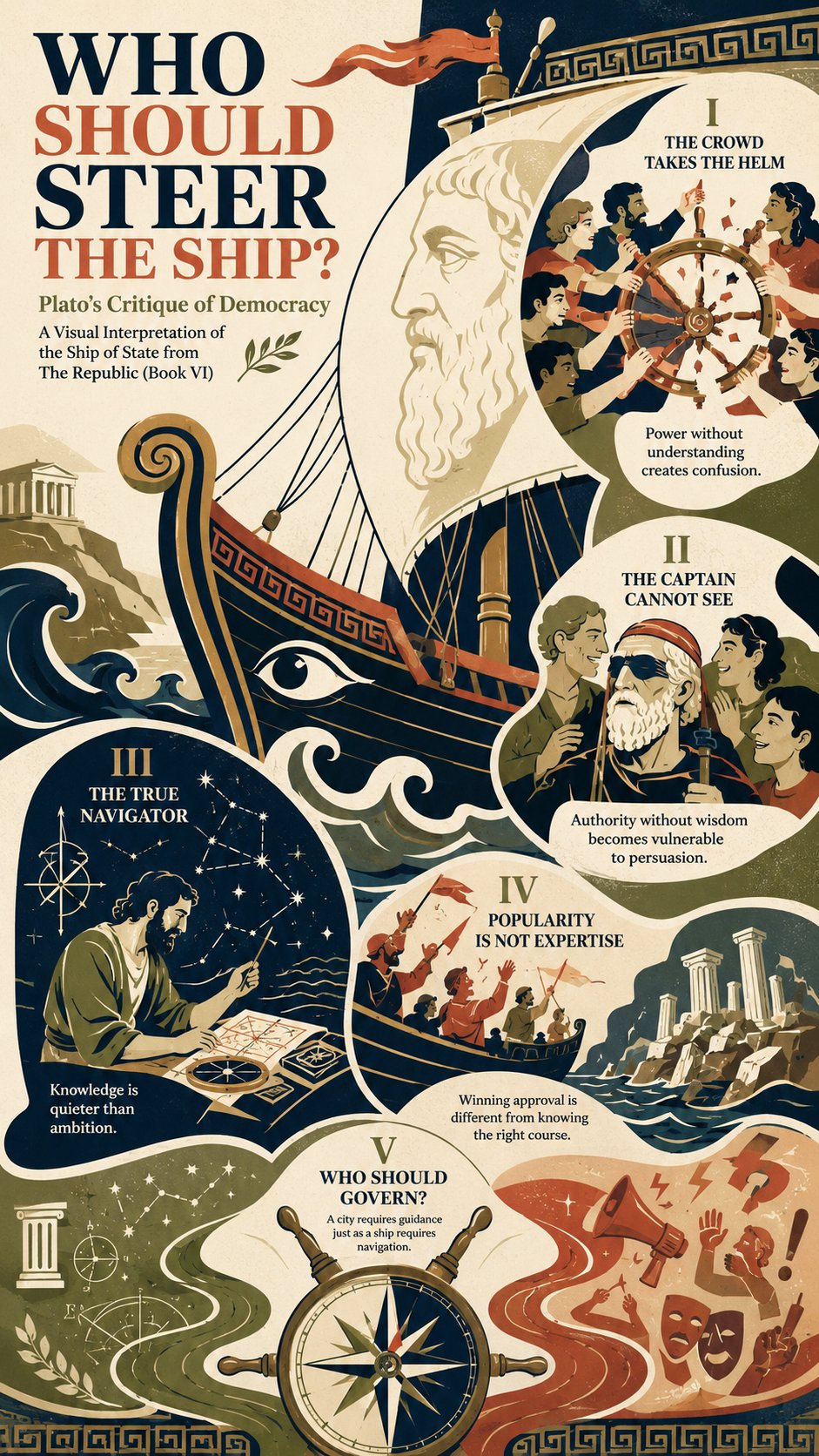
Who Should Steer the Ship? Editorial Áp phích nghệ thuật - Prompt AI Chọn Lọc
Câu Lệnh Prompt Gốc (100% Nguyên Bản)
EDITORIAL CONCEPTUAL POSTER — "WHO SHOULD STEER THE SHIP?" (9:16)

Main Title

WHO SHOULD STEER THE SHIP?

Subtitle


Plato's Critique of Democracy

A visual interpretation of the Ship of State from The Republic (Book VI)


OVERALL ART DIRECTION


Create a single-page editorial conceptual illustration inspired by the uploaded reference image.


Use the reference only as the visual identity:


conceptual magazine illustration

contemporary editorial illustration

bold simplified geometric forms

organic interlocking shapes

layered symbolic storytelling

strong figure-ground relationships

playful but sophisticated composition

flat color planes

clean negative space

minimal but expressive facial features

contemporary publishing illustration

handcrafted print texture

slightly imperfect screen-print appearance


Do not copy the composition, colors, objects, typography, or layout from the reference.


Instead, capture its graphic language and transform it into an entirely original philosophical editorial artwork.


The result should feel suitable for publications such as The New Yorker, The Atlantic, The Economist, or a museum philosophy exhibition.


CORE CONCEPT


The entire page is one visual metaphor answering:


Why did Plato distrust democracy?


The composition should immediately communicate that the problem is not democracy itself, but placing power in the hands of people who lack the knowledge to govern wisely.


Everything revolves around the famous Ship of State allegory.


CENTRAL VISUAL


Instead of a large isolated portrait,


construct a giant symbolic Greek ship occupying almost the entire page.


The ship itself becomes the visual centerpiece.


Its sail subtly forms the profile of Plato's face when viewed from a distance.


The hull, mast, ropes, and waves interlock into one conceptual composition.


The ship should feel monumental.


Not historically accurate.


Instead, it should be a symbolic editorial object.


PLATO


Plato appears only as


a beautifully illustrated head-and-chest Greek marble-like portrait


emerging naturally from the ship itself.


His portrait is integrated into:


the sail

the mast

carved wooden ornament


rather than floating independently.


He acts as the narrator rather than the hero.


INTERACTIVE VISUAL FRAMES


Instead of boxes,


create five large symbolic editorial "windows"


that flow organically around the ship.


Each window resembles an irregular sculpted fragment carved into the composition.


Each one tells one chapter of Plato's argument.


FRAME I

THE CROWD TAKES THE HELM


Illustration


Many sailors all reach for the same steering wheel.


Every hand pulls in a different direction.


No one looks toward the sea.


The wheel itself begins breaking apart.


Visual metaphor:


Many opinions.


No shared knowledge.


Caption


Power without understanding creates confusion.


FRAME II

THE CAPTAIN CANNOT SEE


Illustration


A large aging captain.


Strong.


Respected.


But partially blind.


Unable to navigate.


Other sailors flatter him instead of helping him.


Visual metaphor


Public opinion alone cannot determine truth.


Caption


Authority without wisdom becomes vulnerable to persuasion.


FRAME III

THE TRUE NAVIGATOR


Largest frame.


Illustration


A calm navigator studies


stars

constellations

winds

geometry

sea currents


while ignored by everyone else.


He never shouts.


He simply understands.


The sky becomes an abstract map of knowledge.


Caption


Knowledge is quieter than ambition.


FRAME IV

POPULARITY IS NOT EXPERTISE


Illustration


Several sailors compete by


making speeches

waving banners

pointing dramatically


Meanwhile the ship quietly drifts toward dangerous rocks.


The rocks subtly resemble broken Greek columns.


Caption


Winning approval is different from knowing the right course.


FRAME V

WHO SHOULD GOVERN?


Illustration


The steering wheel transforms into


a philosophical compass.


One path follows


stars

geometry

reason


The other follows


applause

noise

disorder


The compass quietly points toward wisdom.


Caption


A city requires guidance just as a ship requires navigation.


DECORATIVE LANGUAGE


Integrate throughout:


Greek key patterns

stylized waves

compass roses

constellations

Ionic capitals

marble textures

olive branches

rope patterns

circular navigation diagrams

carved medallions

geometric borders

flowing banners

scroll fragments

architectural silhouettes


Everything should feel integrated rather than decorative.


STYLE LANGUAGE


Use the uploaded reference as the defining visual identity.


Preserve:


bold editorial abstraction

oversized symbolic objects

interlocking organic forms

simplified faces

crisp flat colors

contemporary conceptual illustration

asymmetrical but balanced composition

large areas of negative space

visual metaphors replacing literal storytelling

magazine-cover quality composition


Avoid:


photorealism

AI painterly rendering

comic-book illustration

fantasy art

hyper-detailed historical reconstruction

generic infographic boxes

symmetrical museum poster layouts

COLOR PALETTE


Use six flat editorial inks:


warm ivory

deep navy

charcoal black

Greek terracotta

muted olive green

warm ochre


Maintain high graphic contrast with bold silhouettes and restrained color blocking.


FINAL ART DIRECTION


The finished illustration should feel like a high-end conceptual editorial cover, where the title, imagery, and symbolism work together as a single visual argument. The uploaded reference should inform the graphic identity only—its simplified shapes, interlocking forms, flat color planes, editorial clarity, and conceptual storytelling—without copying its specific composition or subject matter.


The headline "WHO SHOULD STEER THE SHIP?" should function as the conceptual hook, immediately drawing the viewer into Plato's critique of democracy. The subtitle "Plato's Critique of Democracy — A Visual Interpretation of the Ship of State" grounds the historical context, while the five integrated visual frames progressively unfold the allegory through symbolic editorial illustration rather than conventional infographic panels. This creates a composition that is visually engaging, intellectually clear, and cohesive with the reference's contemporary editorial aesthetic while remaining entirely original.
[!TIP] Sao chép nguyên vẹn prompt trên và đưa vào mô hình AI tương ứng.
Nguồn: congcu.ai
Comments
Join the discussionNo comments yet. Be the first to comment.
Tutorial
Nơi đây chia sẻ các tutorial, mẹo hay và thủ thuật công nghệ, giúp bạn khám phá công cụ mới và làm việc hiệu quả hơn.