

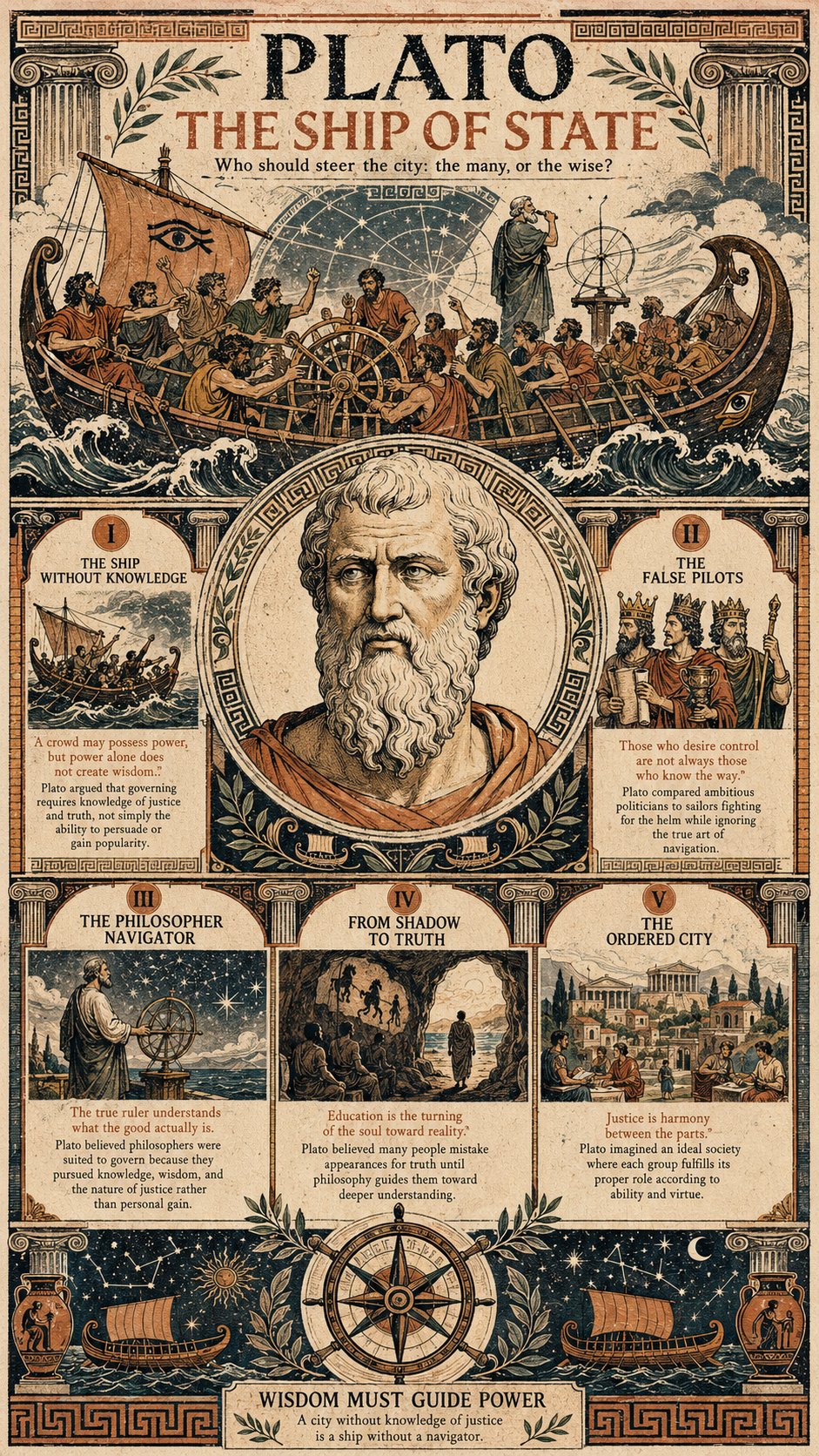
Plato’s Ship of State Risograph Áp phích nghệ thuật - Prompt AI Chọn Lọc
Câu Lệnh Prompt Gốc (100% Nguyên Bản)
EDITORIAL RISOGRAPH POSTER — "PLATO: THE SHIP OF STATE" (9:16)


Create a single-page vertical editorial poster exploring Plato's philosophical critique of democracy through the allegory of the Ship of State from The Republic.


The artwork should explain Plato's argument that governing requires knowledge, wisdom, and philosophical understanding rather than merely popularity, ambition, or the pursuit of immediate desires.


Use the supplied reference image only as inspiration for the artistic language. Do not copy its composition, figures, decorative motifs, or layout.


The finished artwork should resemble a museum-quality handmade Greek editorial screen print, blending classical philosophy, ancient mythology-inspired illustration, and contemporary editorial design.


It should feel like a page from an independent philosophy journal or a museum exhibition poster.


Not a political propaganda poster.


Not a modern infographic.


Not a cartoon.


Not photorealistic.


CORE CONCEPT — THE SHIP OF STATE


The entire poster revolves around Plato's famous allegory:


A ship represents the city-state.


The sailors represent competing political forces.


The captain represents wisdom and knowledge.


The true navigator represents the philosopher who understands the stars, winds, and course of the journey.


The composition should visually tell this philosophical story through a central Greek maritime allegory.


CENTRAL FIGURE — PLATO


A magnificent head-and-chest portrait of Plato occupies the exact center of the composition.


Show only his head and upper chest.


Do not show a full body.


He should appear as the intellectual anchor of the entire poster.


Depict Plato as:


mature Greek philosopher

thoughtful expression

deep-set observant eyes

thick curled beard

wavy classical hair

calm but serious demeanor

simple Greek himation draped across shoulders


He should not appear angry or authoritarian.


He represents philosophical reflection and the search for truth.


Behind Plato rises a monumental circular composition inspired by Greek architectural ornament:


marble rings

Ionic columns

Greek key patterns

celestial navigation circles

carved stone geometry

olive branches

ancient ship motifs


This structure replaces a religious halo.


CENTRAL SYMBOL — THE SHIP OF STATE


Behind and surrounding Plato's portrait, the largest symbolic element is an ancient Greek trireme sailing through a philosophical sea.


The ship should be depicted as an allegorical vessel, not a realistic historical reconstruction.


The ship contains:


many sailors arguing over direction

raised hands representing competing opinions

confused movement on deck

a powerful but untrained crowd attempting to control the vessel

a neglected steering wheel

a symbolic captain's position


Above the ship stands a quiet navigator observing:


stars

celestial patterns

winds

currents


The navigator represents philosophical knowledge.


The ship should curve around Plato's portrait, creating a circular philosophical composition.


STYLE DNA


Maintain the same visual language as the philosophy series:


handmade editorial illustration

contemporary Greek-inspired risograph print

museum-quality screen print

bold imperfect black contour lines

simplified classical anatomy

engraved manuscript feeling

flat ink colors

visible paper texture

dry-brush imperfections

expressive symbolic composition


Inspired by:


ancient Greek vase painting

marble relief sculpture

classical manuscripts

Hellenistic engraving

archaeological museum graphics

independent philosophy publications


Never:


Roman aesthetics

medieval aesthetics

modern political cartoons

clean vector graphics

photorealism

PRINT TEXTURE


Heavy risograph grain.


Visible paper fibers.


Slight ink misregistration.


Dry brush edges.


Uneven ink density.


Hand printed imperfections.


The artwork should feel physically produced on textured paper.


COLOR PALETTE


Use six flat inks:


warm ivory paper

deep black

Greek terracotta

muted ochre

olive green

charcoal gray


Optional subtle muted sea-green accents.


No:


neon

blue-heavy palette

gradients

glossy rendering

metallic effects


The atmosphere should feel like an ancient Greek vase transformed into a modern philosophy poster.


TYPOGRAPHY


Hand-lettered Greek editorial typography.


Bold uppercase title.


Integrated into the artwork.


Slightly imperfect printed alignment.


Classical but readable.


Never modern UI typography.


TITLE

PLATO

THE SHIP OF STATE

Subtitle


"Who should steer the city: the many, or the wise?"


INTERACTIVE FRAME I

THE SHIP WITHOUT KNOWLEDGE

Illustration


A large Greek ship drifting through unstable waters.


The sailors fight over the helm.


Some pull the wheel in different directions.


Others compete for control without understanding navigation.


The sea becomes chaotic.


Symbolism


Power without wisdom creates disorder.


Editorial Text


THE SHIP WITHOUT KNOWLEDGE


"A crowd may possess power, but power alone does not create wisdom."


Plato argued that governing requires knowledge of justice and truth, not simply the ability to persuade or gain popularity.


INTERACTIVE FRAME II

THE FALSE PILOTS

Illustration


Several sailors compete to command the ship.


They hold:


decorative crowns

empty scrolls

symbols of wealth

instruments they do not understand


They represent politicians seeking influence without philosophical understanding.


Editorial Text


THE FALSE PILOTS


"Those who desire control are not always those who know the way."


Plato compared ambitious politicians to sailors fighting for the helm while ignoring the true art of navigation.


INTERACTIVE FRAME III

THE TRUE NAVIGATOR

Illustration


The largest contemplative frame.


A philosopher-navigator stands quietly beside celestial instruments.


He studies:


stars

winds

ocean currents

mathematical patterns


He does not force the ship.


He understands the path.


Editorial Text


THE PHILOSOPHER NAVIGATOR


"The true ruler understands what the good actually is."


Plato believed philosophers were suited to govern because they pursued knowledge, wisdom, and the nature of justice rather than personal gain.


INTERACTIVE FRAME IV

THE CAVE AND THE SHADOWS

Illustration


A Greek cave opening.


Inside:


chained figures watch shadows projected on a wall

outside sunlight reveals the real world

a philosopher turns toward the light


Use symbolic geometry rather than literal horror.


Editorial Text


FROM SHADOW TO TRUTH


"Education is the turning of the soul toward reality."


Plato believed many people mistake appearances for truth until philosophy guides them toward deeper understanding.


INTERACTIVE FRAME V

THE IDEAL CITY

Illustration


A harmonious Greek city arranged with:


balanced architecture

geometric order

philosophers teaching

guardians protecting

citizens working together


The city appears as a carefully designed structure rather than a chaotic crowd.


Editorial Text


THE ORDERED CITY


"Justice is harmony between the parts."


Plato imagined an ideal society where each group fulfills its proper role according to ability and virtue.


BOTTOM SECTION


A Greek compass transforms into a ship's steering wheel.


Around it:


olive branches

stars

waves

geometric patterns

Greek inscriptions rendered as decorative texture


Closing statement:


WISDOM MUST GUIDE POWER


"A city without knowledge of justice is a ship without a navigator."


DECORATIVE MOTIFS


Integrate throughout:


Greek key borders

Ionic columns

marble carving patterns

olive branches

laurel leaves

Greek waves

trireme silhouettes

celestial navigation symbols

stars

compass circles

amphora patterns

ancient scrolls

geometric proportions

architectural arches

carved philosophical tablets

Hellenistic ornamental borders


Every element should guide attention back toward Plato and the Ship of State.


FINAL ART DIRECTION


The final artwork should feel like a museum-quality handmade editorial risograph poster about Hellenistic philosophy.


Plato's head-and-chest portrait remains the intellectual center while the surrounding interactive frames unfold as chapters of the Ship of State allegory.


The design should combine:


Greek classical art

philosophical storytelling

ancient maritime symbolism

editorial hierarchy

tactile printmaking


The result should feel timeless, intellectual, and visually powerful — a philosophical exhibition poster explaining why Plato questioned democracy through one of history's most famous political metaphors
[!TIP] Sao chép nguyên vẹn prompt trên và đưa vào mô hình AI tương ứng.
Nguồn: congcu.ai
Comments
Join the discussionNo comments yet. Be the first to comment.
Tutorial
Nơi đây chia sẻ các tutorial, mẹo hay và thủ thuật công nghệ, giúp bạn khám phá công cụ mới và làm việc hiệu quả hơn.