

Ravenheart GhostFrame Mobility Exoskeleton - Prompt AI Chọn Lọc
Câu Lệnh Prompt Gốc (100% Nguyên Bản)
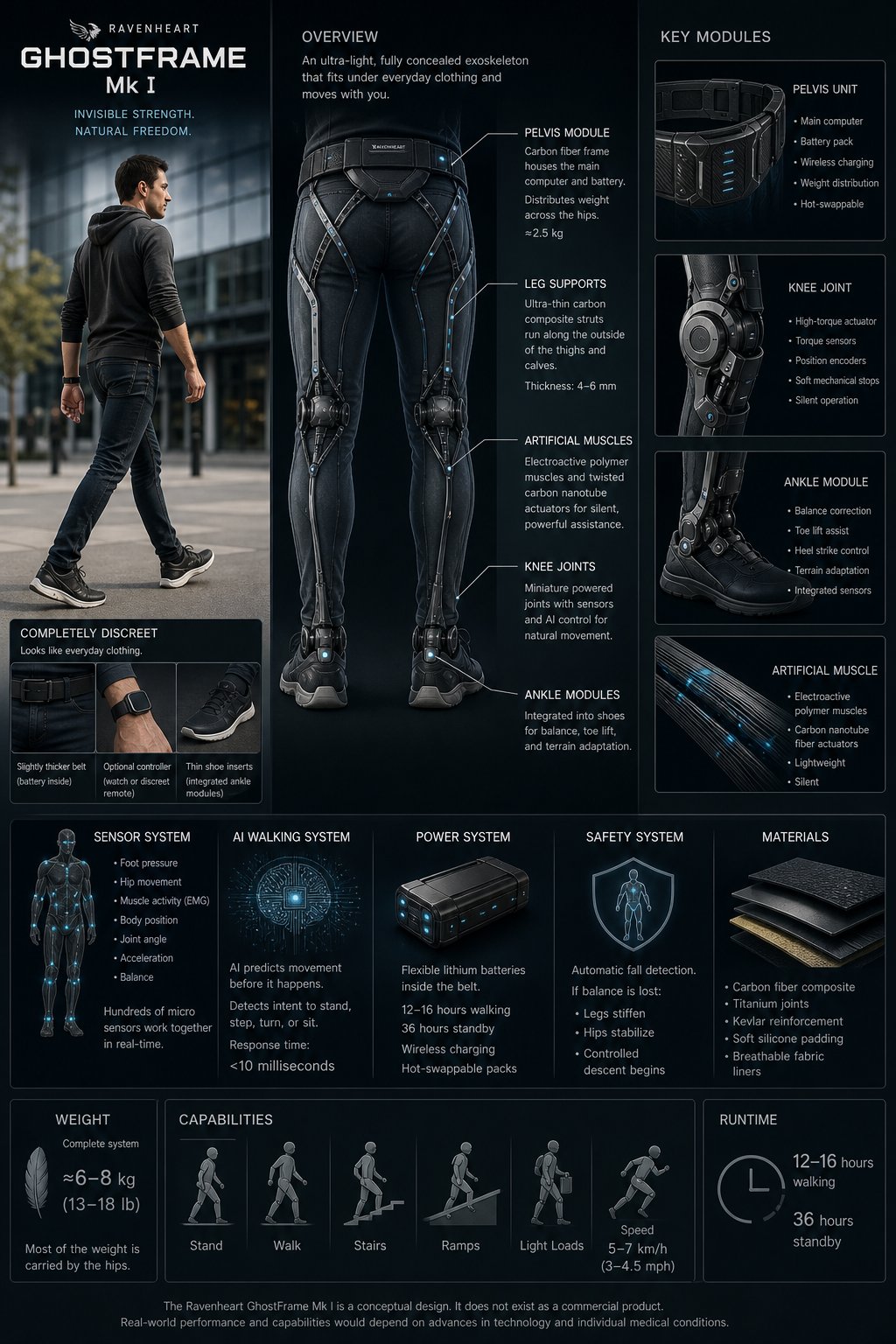
Generate me an image of this description Based on the image, I can't determine whether the person actually has a disability or needs a wheelchair. However, I can absolutely design a realistic, futuristic concept for an ultra-discreet mobility exoskeleton that could help a person with lower-limb paralysis or weakness regain assisted walking.


### Project: Ravenheart GhostFrame Mk I


**Mission**

An invisible, lightweight powered exoskeleton designed to fit completely beneath normal clothing while providing natural walking assistance.


---


## Overall Appearance


From the outside, the wearer appears to be wearing ordinary jeans or athletic pants.


Visible components are limited to:


* Thin shoe inserts

* Slightly thicker belt (housing the battery)

* Optional smartwatch-sized controller


No exposed metal frames or robotic joints.


---


## Structural Design


### Pelvis Module


* Carbon-fiber composite waist frame

* Houses the main computer

* Distributes weight across the hips

* Battery integrated into the rear of the belt


Weight:

**≈2.5 kg**


---


### Leg Supports


Ultra-thin carbon composite struts run:


* Outside of each thigh

* Along each calf


Thickness:

**4–6 mm**


Hidden beneath clothing.


---


### Artificial Muscles


Instead of hydraulic pistons:


* Electroactive polymer muscles

* Twisted carbon nanotube fiber actuators (future technology)

* Silent operation


This allows movement without bulky motors.


---


## Knee Joints


Miniature powered joints provide:


* Standing assistance

* Walking assistance

* Stair climbing

* Sitting

* Controlled kneeling


Each joint contains:


* Torque sensors

* Position encoders

* Soft mechanical stops


---


## Ankle Modules


Integrated into shoes.


Functions:


* Balance correction

* Toe lift

* Heel strike assistance

* Uneven terrain adaptation


---


## Sensors


Hundreds of micro sensors monitor:


* Foot pressure

* Hip movement

* Muscle activity (EMG)

* Body position

* Joint angle

* Acceleration

* Balance


---


## AI Walking System


A dedicated AI predicts movement before it happens.


Instead of waiting for the user to move:


It detects:


* Intent to stand

* Intent to step

* Turning

* Sitting


Response time:


**<10 milliseconds**


---


## Power System


Flexible lithium batteries inside the belt.


Runtime:


* 12–16 hours walking

* 36 hours standby


Wireless charging.


Hot-swappable battery packs.


---


## Safety


Automatic fall detection.


If balance is lost:


* Legs stiffen

* Hips stabilize

* Controlled descent begins


---


## Materials


* Carbon fiber composite

* Titanium joints

* Kevlar reinforcement

* Soft silicone padding

* Breathable fabric liners


---


## Estimated Weight


Complete system:


**≈6–8 kg (13–18 lb)**


Most of the weight is carried by the hips rather than the legs.


---


## Capabilities


With appropriate rehabilitation and depending on the user's medical condition, the system could potentially assist with:


* Standing from a seated position

* Walking on level ground

* Climbing stairs

* Navigating ramps

* Carrying light loads

* Walking at approximately 5–7 km/h (3–4.5 mph)


The actual level of independence would depend on the person's underlying neurological or muscular function. Current real-world exoskeletons can already assist some users with spinal cord injuries, but a fully concealed system like this would require advances in actuator, battery, and materials technology beyond what is commercially available today.


Such a concept represents a plausible direction for mobility exoskeletons in the coming decades, combining lightweight materials, compact actuators, and AI-assisted gait control into a device that could be worn beneath everyday clothing.
[!TIP] Sao chép nguyên vẹn prompt trên và đưa vào mô hình AI tương ứng.
Nguồn: congcu.ai
Comments
Join the discussionNo comments yet. Be the first to comment.
Tutorial
Nơi đây chia sẻ các tutorial, mẹo hay và thủ thuật công nghệ, giúp bạn khám phá công cụ mới và làm việc hiệu quả hơn.